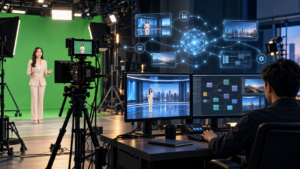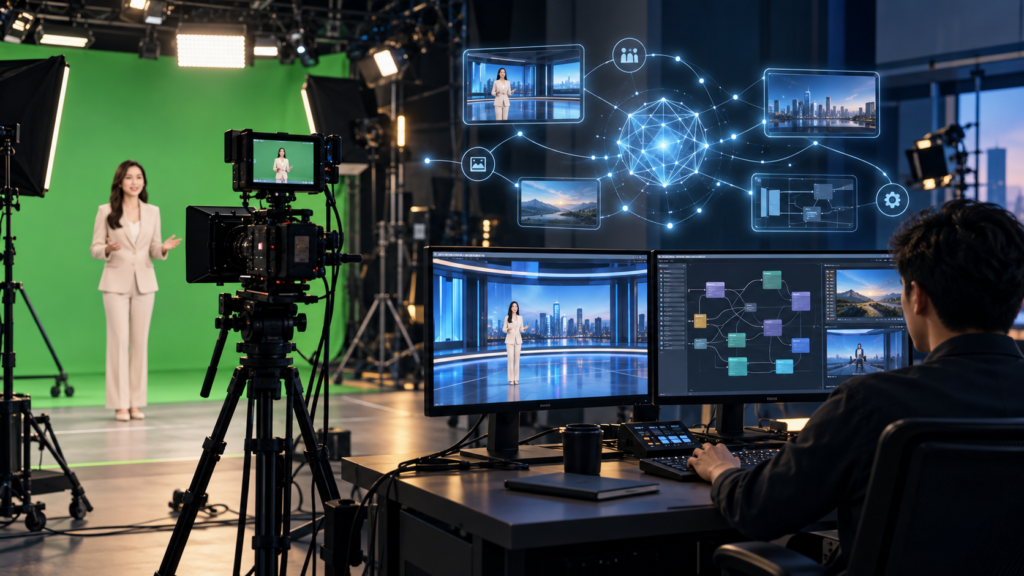
Integrating AI into virtual production is opening up new ways to prepare shows, develop visuals and support studio operators. For businesses producing webinars, product launches and corporate videos, the opportunity is practical: spend less time on repetitive preparation and more time shaping a clear, engaging presentation.
Aximmetry is bringing AI tools closer to the production environment itself. Its latest developments combine AI assistance for operating the software with AI building blocks for creating content inside a show. Here is what the integration means, and how it could benefit projects at our virtual production studio in Singapore.
What is available in Aximmetry’s AI integration?
Release status checked on 2 October 2026. Aximmetry’s official release notes list 2026.4.0 BETA 2, dated 9 September 2026, as the latest beta. The embedded AI Assistant and MCP server were introduced in the 2026.4.0 beta series. These features are available in the Broadcast & Film Edition; lifetime licences require a valid maintenance plan.
AI Compounds are a separate development, introduced in version 2026.2.0. The latest stable release listed is 2026.3.1. This distinction matters when planning an upgrade: content-generation tools and the newer AI control features have different release histories.
AI Assistant and MCP: help with operating Aximmetry
The embedded AI Assistant provides a chat interface within Aximmetry, using a supported AI model and the provider’s API key. MCP, short for Model Context Protocol, connects external AI agents to Aximmetry’s tools. Aximmetry identifies agents such as Claude and Cursor as examples.
According to Aximmetry’s AI integration overview, these tools can assist with project setup, input and output configuration, locating controls, adjusting parameters, Flow Graph scripting and troubleshooting. The aim is to give operators useful assistance within their existing production workflow.
AI Compounds: content creation inside the Flow Graph
Aximmetry’s OpenAI Compounds documentation describes four tools: text chat, image generation, image editing and video generation. These can produce assets or responses within the node-based Flow Graph, where a production team connects the results to its scene.
A generated background image is still a two-dimensional asset. A fully navigable 3D set with correct perspective, lighting and camera movement still needs suitable scene design and technical preparation.
How can integrating AI into virtual production benefit clients?
The following are practical applications we see for corporate production. They are potential workflows to evaluate for each project, rather than claims of measured savings or features already deployed in every production.
1. Faster preparation for webinars and virtual events
A multi-camera show involves more than choosing a backdrop. Inputs, outputs, scene controls and presentation elements must work together. AI assistance could help a technician navigate that setup and review configuration tasks before rehearsal.
For a recurring webinar, the useful starting point is a tested show template. The team can prepare the next episode’s speaker details, presentation screens and scene settings around that template, leaving more rehearsal time for the presenters and programme.
2. Quicker visual exploration before a shoot
Instead of committing immediately to one visual direction, a creative team can explore several concepts for a product launch or interview. AI-generated images could help communicate a mood, colour palette or virtual-screen treatment to the client before detailed production work begins.
This can make feedback more specific: a client can compare options and approve a direction early. Final graphics still need checks for brand accuracy, legibility and suitability for the camera framing.
3. More consistent recurring productions
For a monthly town hall or training series, consistency matters as much as novelty. Aximmetry’s technical explanation of MCP describes assistance with inspecting modules and pin values, adjusting parameters and triggering predefined actions.
A practical application is helping an operator review a reusable setup against an agreed checklist. Keeping approved templates, settings and graphics together makes it easier to carry the same visual identity across episodes and reduces reliance on one person’s memory.
4. Better support for troubleshooting and training
When a scene behaves unexpectedly, technical staff need to find the cause quickly. AI assistance with inspecting compounds and their values could help narrow the investigation, while an experienced operator validates the proposed fix.
For newer crew members, guided explanations can also make unfamiliar controls easier to understand. Rehearsals remain essential: a helpful explanation does not establish that a change is safe for a live show.
Practical applications for Singapore businesses
| Production | Potential AI-assisted workflow | Client benefit |
|---|---|---|
| Webinars and town halls | Prepare episode updates around an approved virtual-studio template. | A consistent presentation with more time for rehearsal. |
| Product launches | Explore background concepts and virtual-screen visuals before building the final show. | Clearer creative choices and earlier feedback. |
| Corporate interviews and training | Develop supporting imagery and draft text for review. | Visual explanations tailored to the audience. |
| Hybrid and virtual events | Assist technical preparation and investigate scene issues during testing. | Better preparation for a programme with multiple sources. |
A sensible workflow for using AI in a live production
Our recommended approach starts with preparation and clear operator control:
- Choose one useful task. Begin with a background concept, a draft graphic or assistance reviewing a setup.
- Test on a separate project. Evaluate beta features before introducing them into a client show.
- Review the result. Check names, facts, logos, visual quality and any rights needed for the intended use.
- Prepare approved assets ahead of time. Store the selected results locally and connect them to the production scene.
- Rehearse the complete show. Check camera framing, graphics, sound and transitions together.
- Keep a fallback ready. Retain approved graphics and manual controls so the programme can continue if an AI request fails.
AI responses are not guaranteed to arrive within a live cue. Aximmetry’s documentation notes that generation can take time and requests can encounter quota, rate-limit or network errors. For scheduled broadcasts, preparing assets before transmission is usually the more dependable starting point.
Frequently asked questions
Does Aximmetry AI integration replace the production crew?
Aximmetry describes an operator-led approach. AI can assist with tasks, but the technical director and creative team still decide what is approved and what goes on air.
Are the AI tools free to use?
OpenAI Compounds require API access, an API key and active billing. Usage costs depend on the model and requests. Confirm Aximmetry licence eligibility and provider costs when budgeting a project.
Can AI create a complete virtual set from one prompt?
Image and video generation can help develop visual assets. That does not automatically produce a production-ready, editable 3D environment. Camera tracking, scene construction and integration still need technical work.
Explore AI-assisted virtual production with WillDylan
At WillDylan, we combine green screen studio production with real-time virtual environments for presentations, webinars and product launches in Singapore. Integrating AI into virtual production offers another way to develop ideas and prepare workflows around your message.
Tell us about your next corporate video, webinar or virtual event. We can discuss where AI assistance could add value, which parts need testing and how to build the project around an approved creative direction.
Contact our team at info@willdylan.com or +65 8157 2857 to discuss your production.